US Higher Education: The 2026 Shift and How Employability is Redefining Its Value

The year 2026 marks a profound structural realignment within the United States higher education sector. For decades, the foundational operating model of American colleges and universities rested on a triad of access, prestige, and enrollment volume. However, a convergence of demographic realities, sweeping federal and state regulatory changes, macroeconomic labor shifts, and the rapid deployment of artificial intelligence has decisively shattered this historical paradigm. In its place, a singular, dominant metric has emerged to determine institutional survival and societal value: employability.
As the long-anticipated demographic cliff officially triggers a projected fifteen-year slide in the population of traditional first-time undergraduates, institutions can no longer rely on a rising tide of high school graduates to sustain tuition revenue. Concurrently, the implementation of the sweeping One Big Beautiful Bill Act (OBBBA) on July 1, 2026, fundamentally rewrites the financial framework of higher education. This legislation directly ties federal student loan eligibility to postgraduate earnings and abruptly eliminates the financial safety net of the Graduate PLUS loan program, effectively capping the amount students can borrow. Simultaneously, state legislatures have transitioned aggressively toward advanced performance-based funding models, rewarding institutions almost exclusively for placing graduates into high-wage, high-demand fields.
Against this backdrop, employers are actively shifting toward skills-first hiring paradigms, placing unprecedented scrutiny on the practical utility of a traditional four-year degree. The result is an ecosystem where employability—defined as a verifiable, positive return on investment via labor market outcomes—is no longer merely a marketing tool for career services offices; it is the ultimate regulatory, financial, and reputational arbiter of global higher education.

US Higher Education Demographic and Financial Crucible of 2026
The structural fragility of the higher education sector has been laid bare by the arrival of the 2026 academic year. Following the peak of eighteen-year-olds in 2025, the sector has entered a protracted period of demographic contraction that shifts the balance of power from institutions to prospective students. This shrinking pipeline is heavily localized and demographically segmented, with traditional white undergraduate enrollment declining by 3.7% annually, while Hispanic, Black, and Multiracial student populations provide the remaining pockets of demographic growth.

Compounding the domestic shortage is a significant deterioration in international student enrollment, particularly at the graduate level, driven by stringent visa policies, protracted delays, and rising geopolitical tensions. Historically, international graduate students have served as a critical financial subsidy for public and private research universities. The rapid decline in this cohort—coupled with macroeconomic projections indicating that the United Kingdom will overtake the United States as the premier destination for international students by 2030—threatens billions in tuition revenue and compromises institutional research capacity.
The internal financial mechanisms of universities are equally strained. Hiring freezes are widespread, with 63% of Ivy League and private R1 institutions, alongside multiple public systems, confirming freezes through the 2026 fiscal year. Merit pools are shrinking to a median of roughly 3%, salary caps are common, and an astonishing 70% of faculty appointments are now non-tenure track, driving rapid unionization momentum.
Furthermore, the implementation of tiered endowment taxes resulting from the OBBBA reconciliation bill has injected severe compliance and financial strain into elite private institutions. The tax structure imposes escalating rates based on the institution's endowment-to-student ratio, effective for fiscal years beginning after December 31, 2025.
Institutions with $500,000 to $750,000 per student face a 1.4% tax, those with up to $2 million face a 4% tax, and endowments exceeding $2 million per student face an 8% levy. This policy directly targets institutional wealth, forcing university administrators to calculate student-adjusted endowment costs, revisit internal spending rules, and prepare for heightened scrutiny from the Internal Revenue Service.
Institutional Attrition, Closures, and Strategic Mergers
The erosion of traditional revenue streams has precipitated a financial crisis across both regional public universities and small-to-mid-sized private liberal arts colleges. Budget deficits, rising operational costs, and the exhaustion of pandemic-era relief funds have accelerated campus closures and program eliminations. Institutions failing to maintain a Composite Financial Index (CFI) above 1.0, or those experiencing enrollment declines exceeding 25% over five years coupled with tuition discount rates above 55%, are facing elevated closure risks.
Rather than facing outright insolvency, a significant portion of the higher education market has witnessed a surge in consolidation to stabilize operations. Strategic acquisitions and mergers have become the preferred survival mechanism for institutions lacking the scale to compete in an outcomes-driven market.
Acquiring Institution | Target Institution | Merger Status / Expected Completion |
Gannon University (PA) | Ursuline College (OH) | Definitive Agreement Reached Jan. 2025 |
Kean University (NJ) | New Jersey City University | Full Merger Effective July 1, 2026 |
Villanova University (PA) | Rosemont College (PA) | Teach-out Period; Full Integration by 2028 |
Elon University (NC) | Queens University of Charlotte | SACSCOC Approval Anticipated June 2026 |
Seattle University (WA) | Cornish College of the Arts | Transaction Closed May 2025 |
For institutions unable to secure acquisition partners, complete cessation of academic operations has become unavoidable. Schools such as Anna Maria College, Providence Christian College, and Lourdes University all announced terminal closures slated for the end of the 2025–2026 academic year, citing unsustainable net tuition revenue losses and enrollment declines ranging from 30% to 70% over the previous decade.
The Regulatory Guillotine: OBBBA and the "Do-No-Harm" Framework
Perhaps the most disruptive force reshaping higher education in 2026 is the activation of the One Big Beautiful Bill Act (OBBBA), signed into law on July 4, 2025. The legislation, combined with the Department of Education's corresponding negotiated rulemaking, shifts the federal posture from an access-focused approach to a strict outcomes-based accountability regime.
The Earnings Premium Metric (STATS)
Taking effect on July 1, 2026, the Student Tuition and Transparency System (STATS) officially overhauls the previous Gainful Employment (GE) and Financial Value Transparency (FVT) frameworks. It introduces a universal "Do-No-Harm" earnings accountability metric applicable to nearly all Title IV-participating programs, regardless of whether the institution operates as a for-profit entity, a private non-profit, or a public university.
The new framework utilizes a singular "earnings premium" calculation designed to empirically ensure that graduates are financially better off than if they had never enrolled. The Department of Education evaluates the median earnings of a program's graduates four years after completion against specific demographic thresholds based on United States Census Bureau data:
Undergraduate and Certificate Programs: Graduates must out-earn the median salary of working adults aged 25–34 in their institution's state who possess only a high school diploma and are not currently enrolled in postsecondary education.
Graduate Programs: Graduates must out-earn the median salary of working adults aged 25–34 with a bachelor's degree. The threshold utilized is the lesser of the state median, the state median within the specific Classification of Instructional Programs (CIP) field, or the national median within the same CIP code.
Programs that fail to meet these thresholds are designated "low-earning outcome programs." If a program fails the metric in two out of any three consecutive years, it loses its eligibility to participate in the federal Direct Loan program for two years.
To enforce systemic compliance, the Department of Education has instituted a severe administrative capability standard. If an institution features a high concentration of failing programs—specifically, if 50% or more of its Title IV recipients or total Title IV funds originate from low-earning programs in two of three consecutive years—the institution is placed on provisional certification status and faces a loss of all Title IV aid eligibility, including Pell Grants, placing it in immediate existential jeopardy. Institutions have highly restricted appeal rights, limited strictly to instances where they can prove the Department of Education made a mathematical error in calculating the earnings premium.
The secondary implications of the STATS framework are profound. Institutions are essentially forced to operate as career placement agencies to maintain their federal funding lifelines. Programs with inherently low-wage trajectories—such as social work, early childhood education, and numerous humanities disciplines—face an acute crisis. While these roles offer immense societal value, their failure to clear statutory earnings premiums will force universities to either aggressively subsidize these programs through private philanthropy, negotiate service-linked tuition agreements with employers, or initiate orderly program closures to preserve the institution's broader Title IV standing.
The Restructuring of Federal Student Loans
The OBBBA simultaneously restructures how students finance higher education, dealing a severe blow to graduate enrollment dynamics. Effective July 1, 2026, the federal government officially discontinues the Graduate PLUS loan program for new borrowers. Historically, Grad PLUS allowed graduate and professional students to borrow up to the full cost of attendance minus other aid, effectively removing price ceilings for master's, law, and medical degrees.
In its place, the federal government has instituted strict, non-inflation-indexed annual and lifetime borrowing limits:

Loan Type / Borrower Category | New Annual Borrowing Limit (Effective 7/1/2026) | New Aggregate Lifetime Borrowing Limit |
Graduate Programs (e.g., standard Master's) | $20,500 | $100,000 |
Professional Programs (e.g., MD, JD) | $50,000 | $200,000 |
Parent PLUS (Dependent Undergraduates) | $20,000 per year | $65,000 per dependent student |
Overall Lifetime Federal Borrowing Cap | N/A | $257,500 (across all federal loan types) |
These caps severely restrict access to expensive graduate and professional degrees. For example, with median annual tuition for medical school exceeding $52,000 and law school reaching $42,000, the $50,000 annual and $200,000 lifetime limits leave vast funding shortfalls for students lacking generational wealth. The transition has not been without controversy; the Department of Education's strict definition of "professional" degrees excluded popular fields like post-baccalaureate nursing and physician assistant programs, subjecting them to the lower $100,000 limit and sparking ongoing federal litigation as of mid-2026.
Current borrowers are shielded by a legacy provision. Students who received a federal Direct Loan or Grad PLUS loan prior to July 1, 2026, may continue to borrow under pre-OBBBA limits for up to three additional academic years or until they complete their program, provided they maintain continuous enrollment in the same program at the same institution. Taking a leave of absence exceeding 180 days, dropping below half-time enrollment, or transferring programs instantly revokes this legacy protection. Furthermore, all federal loans are now subject to strict proration rules, reducing loan eligibility in direct proportion to a part-time student's registered credit load.
Repayment frameworks have also been entirely rewritten. For new loans disbursed after July 1, 2026, the current suite of income-driven repayment plans (IBR, PAYE, SAVE) has been eliminated. Borrowers must choose between a Tiered Standard Plan offering fixed payments over 10 to 25 years based on the loan balance, or the new Repayment Assistance Plan (RAP), an income-driven model that extends the loan forgiveness timeline to 30 years.
State-Level Engineering: The Rise of Performance-Based Funding 2.0
While the federal government targets outcomes via punitive loan restrictions, state governments are utilizing appropriations to proactively engineer their public higher education systems. Traditional higher education funding models, which allocated state tax dollars based on full-time equivalent (FTE) enrollment, are being rapidly dismantled. In early 2026, over 30 states employ "Performance-Based Funding (PBF) 2.0" models, which integrate performance metrics directly into base funding formulas.
The Texas HB 8 Revolution: Credentials of Value
The most radical departure from the enrollment-based model is Texas House Bill 8, which took full effect during the 2024-2025 fiscal cycle and fundamentally dictates community college financing in 2026. Texas completely decoupled community college funding from enrollment hours, shifting to a dynamic, outcomes-based model that pays all fifty public community college districts strictly for the generation of "fundable student outcomes".
Under the Texas formula, the state guarantees a Base Tier of funding to support operational costs for smaller, rural colleges lacking robust local property tax bases, but the vast majority of new appropriations flow through the Performance Tier. Colleges are compensated for producing:
Credentials of Value (COV): Certificates or degrees that yield a positive return on investment by surpassing the cumulative median earnings of high school graduates and recovering the cost of attendance within a defined timeframe.
Successful Transfers: Students completing at least 15 credit hours and successfully transferring to a four-year public or private university.
Dual Credit Completions: High school students completing dual enrollment courses, a metric heavily supported by the state's FAST (Fast Application for Swift Transfer) program.
Crucially, the Texas formula incorporates equity weightings, providing 25% more funding per outcome for graduating economically disadvantaged students (Pell recipients) and academically underprepared students, and a massive 50% bonus for adult learners over age 25. To receive COV funding, institutions must meticulously track their graduates' wage data through the Texas Higher Education Coordinating Board. If a program's graduates fail to meet the wage thresholds, the credential loses its value designation, and the college forfeits the corresponding state allocation.
The Florida Model and Strategic Emphasis
Similarly, Florida’s State University System has refined its Performance-Based Funding Model over the past decade, utilizing metrics to compel universities to prioritize graduate employability. "Metric 1" evaluates the percentage of bachelor's graduates employed with wages exceeding a strictly defined threshold (increased to $40,000) or continuing their education one year after graduation. The state's 2030 Strategic Plan targets an 85% success rate for this specific metric.
Florida has also aggressively curtailed funding for programs outside its "Programs of Strategic Emphasis." Changes instituted for the 2024-2025 academic year dramatically reduced the number of approved programs, heavily penalizing universities that produce graduates in fields deemed unaligned with state economic development goals and forcing institutions to undergo score normalization processes to adapt to the new target lists.
The second-order implications of these state policies are profound. Public universities and community colleges are being systematically repurposed into direct extensions of state economic development and workforce training apparatuses. Academic departments that cannot demonstrate direct linkage to local labor market demand are starved of state appropriations, leading directly to the widespread elimination of liberal arts, humanities, and social science programs.
The Global Employability Context: From Europe to India
The mandate for higher education to guarantee employability is not an isolated American phenomenon, but a global imperative. However, the outcomes vary drastically based on national economic structures and institutional alignment.
In the European Union, the transition from education to employment remains highly efficient. Eurostat data from 2025 indicates that the employment rate for young adults aged 20–34 who recently graduated from upper secondary or tertiary education reached 83.0%. Graduates with tertiary education secured an 87.0% employment rate, vastly outperforming those with only medium education levels. Nations with strong apprenticeship and dual-education models, such as Germany (90.6%) and the Netherlands (90.1%), lead the continent, demonstrating the efficacy of deeply integrated university-industry collaboration.
Conversely, India faces a severe crisis regarding graduate employability, highlighting the dangers of prioritizing educational expansion over labor market alignment. According to the State of Working India 2026 report by Azim Premji University, fewer than 7% of Indian graduates secure permanent salaried roles within a year of completing their studies, and overall unemployment among graduates under 25 has surged to 39.33%. The core issue is a stark skills mismatch. The India Skills Report 2024 revealed that only 47.2% of Indian graduates assessed for employability met the minimum threshold criteria for the roles their qualifications were designed to fill. Engineering graduates showed 43% employability, while general science graduates sat at 38%.
To combat this, the Indian government has aggressively utilized the National Education Policy (NEP) 2020 to enforce practical skills integration. The University Grants Commission (UGC) issued strict guidelines for undergraduate internships, and the National Apprenticeship Training Scheme (NATS) expanded to embed apprenticeship training directly within higher education curricula. Furthermore, programs like the Pradhan Mantri Kaushal Vikas Yojana (PMKVY 4.0) now mandate one-year post-certification tracking of candidates to ensure actual labor market absorption.
Globally, accreditation bodies are stepping in to mandate accountability. For instance, the United Arab Emirates University (UAEU) utilizes the Council for the Accreditation of Educator Preparation (CAEP) standards to enforce rigorous public tracking of employment outcomes. Data tracking reveals that UAEU’s Early Childhood Education program improved its employment rate from 46.8% in 2022 to 75.0% by 2024, demonstrating how targeted institutional focus can reverse poor labor market transitions.
The Labor Market Collision: Underemployment and Skills-First Hiring
The intense regulatory focus on postgraduate earnings coincides with a volatile and increasingly hostile labor market for recent college graduates in the United States. At the start of 2026, the unemployment rate for young college graduates (aged 22–27) reached 5.7%, significantly outpacing the national average and marking a 37-year peak for new workforce entrants' share of total unemployment. More alarming is the underemployment rate—the percentage of college graduates working in jobs that do not typically require a bachelor's degree—which hovered at 41.5%.
The Stagnating Wage Premium and The AI Disruption
The traditional "college wage premium"—the baseline earnings gap between college graduates and high school diploma holders—has flatlined since 2000, while specific technological competencies now dictate market value. Data from the World Economic Forum indicates that verifiable artificial intelligence skills command a 23% wage premium, compared to an 8% baseline premium for a generic bachelor's degree.
The integration of generative AI into corporate workflows is disproportionately eliminating the entry-level, repeatable digital tasks that traditionally served as onboarding mechanisms for recent graduates. Employers, facing the perceived higher costs of training junior staff in remote or hybrid environments, are increasingly bypassing recent graduates in favor of mid-career professionals or leveraging AI for initial analytical output. From 2023 to 2025, industries that traditionally absorb the largest shares of college graduates—including information services, finance, and professional business services—shed an average of 9,000 jobs per month, a stark reversal from pre-pandemic growth trends.
The impact is highly asymmetric across academic disciplines. Fields with embedded, credentialed pipelines exhibit incredible resilience.
Academic Major / Field of Study | Unemployment Rate (Early 2026) | Underemployment Rate (Early 2026) |
Construction Services | 0.69% | Low / Stable |
Special Education | 0.95% | Low / Stable |
Nursing | 1.42% | 12.8% (Lowest overall) |
Computer Science / Engineering | 7.0% - 7.8% | Moderate |
Criminal Justice | N/A | 65.8% |
Performing Arts / Fine Arts | N/A | 63.9% |
Majors that integrate clinical rotations or apprenticeships, such as nursing and education, shield graduates from volatility. Conversely, generic majors face severe underemployment, with broad liberal arts, communications, and anthropology majors experiencing underemployment rates consistently exceeding 50%.
The Transition to Competency and Skills-Based Hiring
Compounding the crisis for traditional degree holders is the widespread corporate adoption of "skills-first" or competency-based hiring. By early 2026, 73% of hiring managers reported evaluating candidates primarily on demonstrated capabilities rather than educational pedigree. Furthermore, an astonishing 71% of employers report utilizing skills-based hiring practices at least half of the time during candidate evaluation.
Major multinational corporations—including IBM, Google, Delta Air Lines, and Bank of America—have formally eliminated four-year degree requirements for vast segments of their organizational charts. The labor market has embraced the "STAR" framework (Skilled Through Alternative Routes), recognizing the nearly 70 million American workers who gained expertise through bootcamps, military service, and hands-on experience as highly desirable, job-ready candidates.
In this environment, employers utilize AI-driven assessments, scenario-based exercises, and practical case studies to validate competencies. The degree itself is no longer viewed as a reliable proxy for capability. Instead, hiring managers prioritize candidates who possess digital fluency combined with robust problem-solving, project management, and data storytelling skills. A generic degree without accompanying, demonstrable technical skills yields a low application response rate of 30-40%, whereas candidates pairing degrees with in-demand technical certifications experience response rates upward of 75%.
Institutional Metamorphosis: Co-Creation and Micro-credentials
To survive the pincers of OBBBA earnings regulations and employer skepticism, higher education institutions are dismantling traditional curricular boundaries. The barrier between academia and industry is dissolving, replaced by models emphasizing co-creation, stackability, and pervasive experiential learning.
Industry-Academia Co-Creation
The era of universities developing curricula in isolation and hoping employers find the graduates useful is effectively over. The prevailing model relies on "co-creation," wherein employers and educators jointly design courses, align syllabi with emerging skill demands, and embed applied corporate projects into graduation requirements.
Prominent examples of this integration include Capgemini partnering with the ESCP Business School to embed live consulting projects into digital transformation modules, and Siemens co-creating mechatronics curricula that allow students to graduate with proprietary Siemens certifications alongside their academic degrees. These partnerships solve the "translation gap" between academic theory and workplace application, ensuring graduates possess the exact vocabulary, tooling proficiency, and pacing required by modern enterprises. Furthermore, universities utilizing co-creation establish deep institutional agility, utilizing corporate feedback loops to adapt research agendas and secure sponsored lab funding without waiting years for traditional curriculum reviews.
The Rise of Micro-credentials and Stackable Pathways
Because the labor market demands agility, the four-year monolithic degree is giving way to stackable, modular credentials. Institutions like Western Governors University (WGU) and Southern New Hampshire University (SNHU) have pioneered the deployment of university-backed micro-credentials and digital badges.
These credentials range from a $2,500 "Applied Business Skills" certificate focusing on regulatory compliance and tort law, to specialized SNHU digital badges in emotional intelligence and data literacy. Crucially, these micro-credentials are not siloed continuing education novelties; they are rigorously aligned with Credit for Prior Learning (CPL) frameworks. A learner can complete an intensive Generative AI micro-credential, utilize those skills immediately for workplace advancement, and apply the badge for up to nine academic credits to accelerate their path into a formal degree program later, potentially reducing the time required for an equivalent course by 75%.
Public institutions are executing similar strategies. Rio Salado College in Arizona partners with the Tempe Chamber of Commerce to offer online, non-credit stackable credentials directly tied to local workforce upskilling. Northern Virginia Community College (NOVA) offers Career Study Certificates (CSCs) that stack directly into Associate of Applied Science degrees, a model supported by the state's G3 (Get Skilled, Get a Job, Get Ahead) tuition assistance program, which has drastically increased internship placements and full-time job acceptances in data center operations and other high-demand fields.
This infrastructure supports the modern "learn-work-learn" lifecycle. It recognizes that in a market where 70% of the skills required for the average job will change by 2030, educational attainment must be continuous, verified, and explicitly mapped to labor market realities.
The Experiential Learning Imperative
To combat underemployment, universities are aggressively expanding Work-Integrated Learning (WIL) and Cooperative Education (Co-op) models. Theoretical coursework is increasingly viewed as insufficient without corresponding practical application. Strategic plans at major institutions, such as the California State University (CSU) system and Brandeis University, now position career placement and guaranteed first-job acquisitions as core Key Performance Indicators (KPIs), shifting focus away from mere graduation rates.
Universities are embedding required clinicals, student teaching, peer mentoring, and paid corporate co-ops directly into the credit structure. By forcing students to navigate the labor market prior to graduation—through international exposure programs, undergraduate research, or service-learning—institutions mitigate the risk of post-graduation underemployment and ensure their programs will satisfy the rigid wage requirements of both state PBF formulas and federal OBBBA thresholds.
The Liberal Arts Paradox and the Accreditation Response
The immediate reaction to the employability crisis has been a brutal culling of humanities and liberal arts programs. Facing budget deficits and the threat of OBBBA sanctions, institutions across the country have gutted departments deemed economically unviable. Portland State University, The New School, Baldwin Wallace University, and the University of North Carolina are among the dozens of institutions that have eliminated majors in philosophy, history, sociology, and languages, citing low enrollment and weak financial contribution.
However, a profound paradox is unfolding in the corporate sector. As artificial intelligence automates complex technical execution—commoditizing coding, basic financial analysis, and routine digital marketing—the durable skills required to manage AI are exactly those cultivated by the liberal arts: critical thinking, ethical reasoning, adaptability, and emotional intelligence.
In the 2026 labor market, AI serves as the "new calculator." Technical proficiency is expected, but the differentiating factor for high-wage employment is the human capacity to define the strategy, interrogate algorithms for bias, and communicate the outputs effectively to non-technical stakeholders. Studies reveal that 93% of employers prioritize written communication, ethical judgment, and lateral thinking—faculties that AI cannot replicate.
Consequently, the liberal arts are not dying; they are being repackaged and operationalized. Successful institutions are blending foundational liberal arts pedagogies with technical micro-credentials. A philosophy major combined with a data analytics digital badge produces the "strategic doer" that modern employers covet. The survival of the humanities depends entirely on linking their inherent intellectual rigor to experiential learning, transforming theoretical inquiry into verifiable labor market agency.
Modernizing Accreditation Standards
Accreditation bodies are responding to these shifts by overhauling their standards to reflect the primacy of data-driven student outcomes. The United States Department of Education (USDE) issued a Request for Information (RFI) to update the Accreditation Handbook, aiming to eliminate outdated geographic scope requirements and reduce administrative burdens that hinder the entry of new accreditors. The Council for Higher Education Accreditation (CHEA) actively advocates for these reforms, emphasizing that accreditation must focus on measurable outcomes rather than enforcing ideological or institutional hiring mandates.
Similarly, global business accreditors are adapting rapidly. The Association to Advance Collegiate Schools of Business (AACSB) launched the first-of-its-kind AI Use Case Hub, crowd-sourcing responsible generative AI applications to streamline accreditation reporting and enhance curricular delivery. The organization is executing a comprehensive Standards Refresh Project in 2026, explicitly aligning global business standards with technology adoption, research impact, and societal relevance, proving that programmatic quality is now measured by its responsiveness to technological disruption.
Redefining Institutional Prestige: Rankings and Public Trust
The reorientation of higher education around employability is definitively reflected in how institutional prestige is measured and perceived. The era of evaluating universities based on exclusivity, incoming SAT scores, and library size has ended.
Methodology Shifts in National Rankings
The premier institutional arbiters have fundamentally altered their methodologies to prioritize social mobility and postgraduate financial outcomes. The 2026 U.S. News & World Report methodology attributes a massive 52% weight to Student Outcomes, explicitly evaluating institutions on graduation rates for Pell Grant recipients, graduate earnings power (comparing alumni against peer cohorts possessing only high school diplomas), and borrower debt reduction. Conversely, the publication dropped legacy metrics like class size and alumni giving.
Forbes' "America's Top Colleges" list further solidifies this trend by weighting median 20-year salaries, average student debt, and overall financial return on investment. Elite institutions like MIT, Princeton, and Stanford continue to dominate not merely through historical prestige, but because their graduates yield median 20-year salaries approaching $200,000 against negligible debt loads.
The Carnegie Classifications have also adapted, introducing a "Student Access and Earnings Classification." This framework evaluates institutions by comparing their Pell Grant access and post-attendance median earnings against the specific geographic and socioeconomic demographics they serve, proving that prestige is now inextricably linked to equitable economic enablement rather than mere academic elitism.
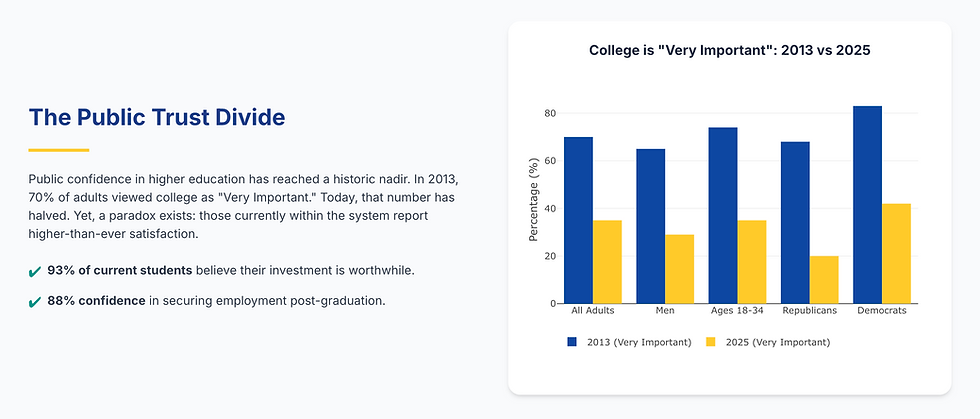
Bridging the Public Trust Divide
The higher education sector must navigate these changes amidst historically fragile public trust. As of late 2025 and early 2026, Gallup polling data reveals that the perceived importance of a college education has plummeted across all demographics.
Demographic Subgroup | 2013: % Saying College is "Very Important" | 2025: % Saying College is "Very Important" |
All U.S. Adults | 70% | 35%38 |
Men | 65% | 29%77 |
Ages 18 to 34 | 74% | 35%76 |
College Graduates | 78% | 40%76 |
Democrats | 83% | 42%76 |
Republicans | 68% | 20%76 |
Skepticism is driven primarily by exorbitant costs (cited by 24% of skeptics), concerns over campus politicization and indoctrination (38%), and the overwhelming perception that universities fail to teach relevant workforce skills (32%).
Yet, a fascinating dichotomy exists between the general public and the consumers actually operating within the system. Among currently enrolled students, 93% of bachelor's degree seekers and 89% of associate degree seekers believe their investment is worthwhile.
Furthermore, 88% of current students express confidence that their degree will secure employment, and 75% of recent alumni state their degree was critical or important to achieving their career goals, directly refuting the public narrative of widespread academic disillusionment.
To bridge this trust deficit, institutions must leverage their outcomes data. The federal reporting requirements mandated by OBBBA, while administratively punitive, provide the exact empirical data required to prove value to an increasingly skeptical public. By aggressively marketing their experiential learning models, transparently publishing their STATS earnings premiums, and guaranteeing skill alignment with local industries, universities can effectively combat the narrative of the useless degree.
Conclusion
The higher education landscape of 2026 represents the culmination of a fierce, multi-decade market correction. The convergence of the demographic enrollment cliff, the severe regulatory mechanisms of the One Big Beautiful Bill Act (OBBBA), outcomes-based state funding models like Texas HB 8, and the AI-driven skills-first labor market have permanently altered the trajectory of the American university system.
The institutions positioned to thrive in the coming decade are those that have dismantled the traditional barriers between academia and the workforce. They operate as dynamic engines of economic mobility, offering stackable micro-credentials, deep industry co-creation, and mandatory experiential learning that validates student competencies. Conversely, institutions that cling to outdated enrollment-based models, rely on generic degrees with unverifiable outcomes, or fail to adjust to the stark new realities of federal borrowing caps will face rapid, unavoidable insolvency. Employability is no longer a downstream byproduct of a college education; it is the fundamental core around which the entire 21st-century academic enterprise must be organized.
Works cited
9 Higher Ed Trends Shaping 2026 - Tyton Partners, https://tytonpartners.com/higher-education-trends-in-2026/
Higher education in 2026: 5 trends reshaping the landscape - WTW, https://www.wtwco.com/en-us/insights/2026/01/higher-education-in-2026-5-trends-reshaping-the-landscape
2026 Gainful Employment - nasfaa, https://www.nasfaa.org/ge_2026
OBBBA Financial Aid Updates - Scarlet Hub, https://scarlethub.rutgers.edu/obbba-financial-aid-updates/
Grad PLUS Loans Ending in 2026: New Borrowing Rules + Limits - Saving For College, https://www.savingforcollege.com/article/grad-plus-loan-changes-2026
Success Measures Matter: How States Are Tying Funding to Student Outcomes, https://www.richmondfed.org/region_communities/regional_data_analysis/community_college_survey/community_college_insights/2025/success_measures_matter_funding_student_outcomes
Texas HB 8: Community College Funding | Prentus, https://prentus.com/blog/texas-hb8-outcomes-funding-community-colleges
Texas's House Bill 8 - ACCT, https://www.acct.org/center-for-policy-practice/DualEnrollment/TX-House-Bill-8
Which Skills Employers Want Most in 2026 (Beyond a Degree) - Profcyma, https://profcyma.com/blogs/skills-employers-want-most-2026/
Why Employers Care More About Tech Skills Than Your Degree in 2026 - Scholaro, https://www.scholaro.com/db/News/tech-skills-vs-degree-2026-340
Top 50 Skills-Based Hiring Trends and Statistics for 2026 - iMocha, https://www.imocha.io/blog/skills-based-hiring-trends
Higher education trends: How to reposition public four‑year universities for the next decade, https://www.bakertilly.com/insights/higher-education-trends-reposition-for-the-next-decade
The US Higher Education Market Landscape in 2026 | QS, https://www.qs.com/insights/the-us-higher-education-market-landscape-in-2026
2026 Higher Education Trends | Deloitte Insights, https://www.deloitte.com/us/en/insights/industry/articles-on-higher-education/2026-higher-education-trends.html
One Big Beautiful Bill's Impact on Higher Education - The Conference Board, https://www.conference-board.org/research/ceo-center-newsletters-alerts/one-big-beautiful-bill-impact-on-education
8 Colleges Closing In 2026: Full List Of Closures, https://thecollegeinvestor.com/79342/8-colleges-closing-in-2026-full-list-of-closures/
2026 Trends in Higher Education - Hanover Research, https://www.hanoverresearch.com/reports-and-briefs/higher-education/2026-trends-in-higher-education/
U.S. Department of Education Issues Final Rule to Hold All Colleges and Universities Accountable for Low-Earning Programs, https://www.ed.gov/about/news/press-release/us-department-of-education-issues-final-rule-hold-all-colleges-and-universities-accountable-low-earning-programs
Accountability in Higher Education and Access Through Demand-Driven Workforce Pell: Student Tuition and Transparency System (STATS) and Earnings Accountability - Federal Register, https://www.federalregister.gov/documents/2026/04/20/2026-07666/accountability-in-higher-education-and-access-through-demand-driven-workforce-pell-student-tuition
Education Department Proposes New Earnings Accountability Framework for Higher Education - McGuireWoods, https://www.mcguirewoods.com/client-resources/alerts/2026/5/education-department-proposes-new-earnings-accountability-framework-for-higher-education/
U.S. Department of Education Proposes Earnings Premium Metric for Postsecondary Programs | Insights | Holland & Knight, https://www.hklaw.com/en/insights/publications/2026/04/us-department-of-education-proposes-earnings-premium-metric
Accountability in Higher Education and Access through Demand-Driven Workforce Pell: Student Tuition and Transparency System and Earnings Accountability - Regulations.gov, https://www.regulations.gov/document/ED-2026-OPE-0100-0001
One Big Beautiful Bill Act Changes That Will Impact Student Cash Flow - CapinCrouse, https://capincrouse.com/one-big-beautiful-bill-act-higher-education-provisions-cash-flow/
Key Changes to Federal Student Loans Made in the One Big Beautiful Bill Act, https://sfs.harvard.edu/changes-federal-student-loans
State Priorities for Higher Education in 2026 - SHEEO, https://sheeo.org/wp-content/uploads/2026/01/Policy-Issue-Survey.2026.pdf
One Big Beautiful Bill Act (OBBBA) Financial Aid Updates, https://financialaid.tcnj.edu/one-big-beautiful-bill-act-financial-aid-updates/
One Big Beautiful Bill Act (OBBBA) - USC Financial Aid, https://financialaid.usc.edu/obbba/
Federal Loan Changes (Effective July 1, 2026) - Financial Aid - Santa Clara University, https://www.scu.edu/financialaid/federal-loan-changes-effective-july-1-2026/
Federal Student Loans: Changes Effective July 1st, https://www.americanbar.org/advocacy/governmental_legislative_work/publications/washingtonletter/june-26-wl/federal-student-loans-update-0626wl/
What Does the One Big Beautiful Bill Mean for Higher Education - McAllister & Quinn, https://jm-aq.com/obbb-higher-education-student-aid-workforce-pell-grants/
One Big Beautiful Bill Act (OBBBA) Financial Aid Updates, https://hmsom.edu/en/student-resources/student-financial-services/obbba
Performance-Based Funding for Higher Education - SHEF, https://shef.sheeo.org/performance-based-funding-for-higher-education/
House Bill 8 (88R) Transformed Community College Finance Through Outcomes-Based Funding - Texas 2036, https://texas2036.org/wp-content/uploads/2025/01/HB-8-One-Pager.pdf
US News College Rankings: History, Purpose, Methodology, Controversies, https://www.academicjobs.com/higher-education-news/us-news-college-rankings-history-methodology-and-controversies-18609
Ranking The Best College Degrees for Employment in 2026 | National University, https://www.nu.edu/blog/best-college-degrees-for-employment/
Students Report Positive College Experiences Despite Declining Public Confidence, Gallup-Lumina Study Finds | The EDU Ledger, https://www.theeduledger.com/students/article/15818000/students-report-positive-college-experiences-despite-declining-public-confidence-galluplumina-study-finds
Community College Finance - Texas Higher Education Coordinating Board, https://www.highered.texas.gov/community-college-finance/
Perceived Importance of College Hits New Low - Gallup News, https://news.gallup.com/poll/695003/perceived-importance-college-hits-new-low.aspx
U.S. Public Trust in Higher Ed Rises From Recent Low - Gallup News, https://news.gallup.com/poll/692519/public-trust-higher-rises-recent-low.aspx
Community College Finance FAQ - Texas Higher Education Coordinating Board, https://www.highered.texas.gov/community-college-finance/community-college-finance-faqs/
2026 Performance-Based Funding - State University System of Florida, https://www.flbog.edu/wp-content/uploads/2026/06/Performance-Based-Funding-Details-1.pdf
For New Grads Looking for Work, the Struggle Is Real – But Not for All - Indeed Hiring Lab, https://www.hiringlab.org/2026/04/23/new-grads-looking-for-work-the-struggle-is-real/
'Just not monetizable': humanities programs face existential crisis at US universities, https://www.theguardian.com/us-news/2026/jan/20/universities-humanities-programs
Employment of recent graduates reached 83% in 2025 - News articles - Eurostat, https://ec.europa.eu/eurostat/web/products-eurostat-news/w/ddn-20260615-1
Industry–academia co-creation: From skills gap to hiring advantage - ET Education, https://education.economictimes.indiatimes.com/blog/industryacademia-co-creation-from-skills-gap-to-hiring-advantage/124358686
India's graduate employment gap widens as education outpaces opportunity - HR ASIA, https://hr.asia/asia-2/indias-graduate-employment-gap-widens-as-education-outpaces-opportunity/
India's Education-to-Employment Gap: Why 53% of Graduates Are Underemployed and What Fixes It | Dheya Insights, https://www.dheya.com/insights/india-education-to-employment-gap
GOVERNMENT OF INDIA MINISTRY OF EDUCATION DEPARTMENT OF HIGHER EDUCATION LOK SABHA UNSTARRED QUESTION NO-1260 ANSWERED ON-08/12/ - Digital Sansad, https://sansad.in/getFile/loksabhaquestions/annex/186/AU1260_jB8RSD.pdf?source=pqals
Trends & Predictions - Job Market - NACE, https://www.naceweb.org/job-market/trends-and-predictions/
2026 CAEP Annual Report – Accountability Measures, https://www.uaeu.ac.ae/en/cedu/pdf/accreditation/am4_2026annualaccreditationreport.pdf
The Labor Market for Recent College Graduates - Federal Reserve Bank of New York, https://www.newyorkfed.org/research/college-labor-market
New Batch of College Graduates Faces an Increasingly Shaky Job Market - Kelly Services, https://www.kellyservices.com/insights/new-batch-of-college-graduates-faces-an-increasingly-shaky-job-market
More Degrees, Tougher Odds: Why the Job Market in 2026 Leaves New Grads Behind, https://www.ibisworld.com/blog/2026-job-market-leaves-new-grads-behind/1/1126/
Class of 2026: Young college graduates face a weaker labor market—but a more mixed picture than the headlines suggest | Economic Policy Institute, https://www.epi.org/blog/class-of-2026-young-college-graduates-face-a-weaker-labor-market-but-a-more-mixed-picture-than-the-headlines-suggest/
Campus closures, mergers, and cuts: a summer 2026 survey | Bryan Alexander, https://bryanalexander.org/horizon-scanning/campus-closures-mergers-and-cuts-a-summer-2026-survey/
What the public thinks vs. what students say - Community College Daily, https://www.ccdaily.com/2026/02/what-the-public-thinks-vs-what-students-say/
School–University Partnerships for Place-Based Educational Administration Innovation: Fostering Innovative Co-Creator Learners - MDPI, https://www.mdpi.com/2227-7102/16/3/440
Forbes America's Top Colleges List 2026 - Best US Universities Ranked, https://www.forbes.com/top-colleges/
U.S. News Announces 2026 Best Colleges Rankings, https://www.prnewswire.com/news-releases/us-news-announces-2026-best-colleges-rankings-302563669.html
An Analysis of the 2025 U.S. News & World Report Rating of SAU - Saint Augustine's University, https://www.st-aug.edu/wp-content/uploads/2025/03/2024-2025-REPORT.pdf
Preparing University Graduates for the Labour Market Through Employability Skills Development and University–Industry Collaboration - PURE.EUR.NL., https://pure.eur.nl/files/233734867/Preparing_University_Graduates_for_the_Labour_Market_Through_Employability_Skills_Development_and_University_Industry_Collaboration.pdf
SNHU Advances Workforce Skilling with New Professional Skills Microcredentials at a Time of Rapid Change, https://www.snhu.edu/about-us/newsroom/briefs/new-professional-skills-microcredentials
WGU Micro-credential in Applied Business Skills, https://badgr.com/public/badges/qK-EeY9lSWyeOHeYw87G8g
Certificate Programs - Western Governors University, https://www.wgu.edu/online-degree-programs/certificates.html
Faculty Reductions & Program Cuts at New School - AcademicJobs.com, https://www.academicjobs.com/higher-education-news/faculty-reductions-and-program-cuts-at-institutions-like-the-new-school-857
Upskilling with Digital Badges - Southern New Hampshire University, https://www.snhu.edu/admission/transferring-credits/digital-badges
What Microcredentials Look Like at 3 Colleges and Universities - WGU Labs, https://www.wgulabs.org/posts/what-microcredentials-look-like-at-3-colleges-and-universities%20
Why AI is 'resurrecting' the liberal arts for the Class of 2026 | Wake Forest News, https://news.wfu.edu/2026/04/29/why-ai-is-resurrecting-the-liberal-arts-for-the-class-of-2026/
Cooperative education: a mini review of benefits and challenges for the developing countries - Frontiers, https://www.frontiersin.org/journals/education/articles/10.3389/feduc.2026.1794804/full
7 Trends That Will Reshape Higher Education in 2026 - ETS, https://www.ets.org/insights-and-perspectives/7-trends-that-will-reshape-higher-education-in-2026.html
School Partnerships & Experiential Learning 2026 - Silver Fern Education Consultants, https://thesfedu.com/school-partnerships-experiential-learning-2026/
Why Experiential Learning Is Essential for Students in 2026? - Eduquest, https://edu-quest.in/why-experiential-learning-is-essential-for-students-in-2026/
Experiential Learning Beyond Co-op | University of Cincinnati, https://www.ccps.uc.edu/what-is-coop/experiential-learning.html
The Enduring Value of a Liberal Arts Education in the Age of AI - Waring School, https://www.waringschool.org/news/the-enduring-value-of-a-liberal-arts-education-in-the-age-of-ai/
Do Liberal Arts Majors Have an Advantage in the Age of AI? - Vault, https://vault.com/blogs/admit-one-vaults-mba-law-school-and-college-blog/do-liberal-arts-majors-have-an-advantage-in-the-age-of-ai
Why the liberal arts can help young Americans prepare for the era of AI - CBS News, https://www.cbsnews.com/news/ai-artificial-intelligence-college-major-skills/
2026 AI, Automation, and the Future of Humanities Degree Careers | Research.com, https://research.com/advice/ai-automation-and-the-future-of-humanities-degree-careers
In the age of AI, human skills are the new advantage - The World Economic Forum, https://www.weforum.org/stories/2026/01/ai-and-human-skills/
Empowering learning through co-creation - International Baccalaureate®, https://ibo.org/news/news-about-the-ib/empowering-learning-through-co-creation/
February 2026 | Council for Higher Education Accreditation - CHEA.org, https://www.chea.org/february-2026
2025 State of Accreditation Report - AACSB, https://www.aacsb.edu/insights/reports/2025/2025-state-of-accreditation-report
2025 Student Access and Earnings Classification, https://carnegieclassifications.acenet.edu/carnegie-classification/classification-methodology/2025-student-access-and-earnings-classification/
College students believe in the value of their degree, 2026 Lumina-Gallup research shows, https://www.ednc.org/3-10-2026-college-students-believe-in-the-value-of-their-degree-2026-lumina-gallup-research-shows/


Comments